Showing posts with label solemnity. Show all posts

Thursday, March 24, 2011

The Annunciation of the Lord - Solemnity

The following is a shameless reprint of the reflection found in the "Catholic Calendar" application found in the App Store (author unknown).  I don't claim any authorship at all, I just found it cool and thought you might too.

The Annunciation of the Lord - Solemnity

What if she had said No?

The question may strike you as irreverent.  How dare I suggest that the Blessed Virgin Mary, Queen of Heaven, Co-Redemptrix of mankind, could have left us in the lurch like that? 

But what if she had?

Could she have said No?  You might say that of course she couldn’t, she was far too holy — but you would be guilty of demeaning and dangerous sentimentality.  It is demeaning because it turns Our Lady from a free human being into a sanctified automaton.  The whole glory of the Annunciation is that Mary, the second Eve, could have said No to God but she said Yes instead.  That is what we celebrate, that is what we praise her for; and rightly so.

This sentimental view is dangerous too.  If we believe that the most important decision in the history of the world was in fact inevitable, that it couldn’t have been otherwise, then that means it was effortless.  Now we have a marvellous excuse for laziness.  Next time we’re faced with a tough moral decision, we needn’t worry about doing what is right.  Just drift, and God will make sure that whatever choice we make is the right one.  If God really wants us to do something he’ll sweep us off his feet the way he did Mary, and if he chooses not to, it’s hardly our fault, is it?

So Mary could have said No to Gabriel.  What if she had?  He couldn’t just go and ask someone else, like some sort of charity collector.  With all the genealogies and prophecies in the Bible, there was only one candidate.  It’s an alarming thought.  Ultimately, of course, God would have done something: the history of salvation is the history of him never abandoning his people however pig-headed they were.  But God has chosen to work through human history.  If the first attempt at redemption took four thousand years to prepare, from the Fall to the Annunciation, how many tens of thousands of years would the next attempt have taken?

Even if the world sometimes makes us feel like cogs in a machine, each of us is unique and each of us is here for a purpose: just because it isn’t as spectacular a purpose as Mary’s, it doesn’t mean that it doesn’t exist.  When we fail to seek our vocation, or put off fulfilling some part of it, we try to justify ourselves by saying that someone else will do it better, that God will provide, that it doesn’t really matter.  But we are lying.  However small a part I have to play, the story of the Annunciation tells me it is my part and no-one else can do it.

Faced with the enormity of her choice, how was Mary able to decide?  If she said No, unredeemed generations would toil on under the burden of sin.  If she said Yes, she herself would suffer, and so would her Son; but both would be glorified.  Millions of people not yet born would have Heaven open to them; but millions of others would suffer oppression and death in her son’s name.  The stakes were almost infinite.

You might say that Mary didn’t worry about all this, just obeyed God; but I don’t believe it.  What God wanted was not Mary’s unthinking obedience but her full and informed consent as the representative of the entire human race.  The two greatest miracles of the Annunciation are these: that God gave Mary the wisdom to know the consequences of her decision, and that he gave her the grace not to be overwhelmed by that knowledge.

When we come to an important decision in our lives, we can easily find our minds clouded by the possible consequences, or, even more, by partial knowledge of them.  How can we ever move, when there is so much good and evil whichever way we go?  The Annunciation gives us the answer.  God’s grace will give us the strength to move, even if the fate of the whole world is hanging in the balance.  After all, God does not demand that our decisions should be the correct ones (assuming that there even is such a thing), only that they should be rightly made.

There is one more truth that the Annunciation teaches us, and it is so appalling that I can think of nothing uplifting to say about it that will take the sting away: perhaps it is best forgotten, because it tells us more about God than we are able to understand.  The Almighty Father creates heaven and earth, the sun and all the stars; but when he really wants something done, he comes, the Omnipotent and Omniscient, to one of his poor, weak creatures — and he asks.

And, day by day, he keeps on asking us.

The Great Catholic Steak Out

Lest you think I suffer from a grammar deficit, I don't mean stake out, I mean steak out.  As in, get the steak out, it's time to eat!

Friday, March 25 is the Solemnity of the Annunciation of the Lord. That ain't no minor thing, that's a Big Deal (tm).  The Church wants us to Celebrate -- not celebrate, I said Celebrate.
Can.  1251 Abstinence from meat, or from some other food as determined by the Episcopal Conference, is to be observed on all Fridays, unless a solemnity should fall on a Friday. Abstinence and fasting are to be observed on Ash Wednesday and Good Friday.
Being obedient sons and daughters of the Church, the same filial duty that makes us fast and abstain from meat impels us not to fast and abstain on a Solemnity even during Lent.  This has nothing to do with being weak, not being able to "tough it out", being legalistic, trying to be more Catholic than the Pope, or any such nonsense. This is about love -- love is obedient.

So we do what we're supposed to do when we're supposed to do it. Kneel when we kneel, stand when we stand, fast when we fast, abstain when we abstain, and don't when we don't.

So fire up the barbecue, roast the brats, smother the chicken, fry the burger or whatever you like and raise a glass to the Queen of Heaven -- she said yes! -- and her glorious Son, Our Lord.

Friday, December 31, 2010

Gate Of Heaven, Star Of The Sea

Jan 1 is the Solemnity of Mary, Mother of God.

The Solemnity of Mary Mother of God commemorates the divine motherhood of the Blessed Virgin Mary, the God-Bearer, Mother of our Lord and God Jesus Christ. It is celebrated on January 1st, one week after Christmas.

Loving Mother of the Redeemer,
Gate of heaven, star of the sea,
Assist your people
who have fallen yet strive to rise again,
To the wonderment of nature you bore your Creator,
yet remained a virgin after as before,
You who received Gabriel's joyful greeting,
have pity on us, poor sinners.

[ChurchYear.Net] In the 4th and 5th centuries debates about the nature of Christ raged in the Church. The debate was about the relationship of Christ's divine and human natures. At the center of this debate was a title of Mary. Since at least the 3rd century, Christians had referred to Mary as theotokos, meaning "God-bearer." The first documented usage of the term is in the writings of Origen of Alexandria in AD 230. Related to theotokos, Mary was called the mother of God.

Referring to Mary this way was popular in Christian piety, but the patriarch of Constantinople from 428-431, Nestorius, objected. He suggested that Mary was only the mother of Jesus' human nature, but not his divine nature. Nestorius' ideas (or at least how others perceived his arguments) were condemned at the Council of Ephesus in AD 431, and again at the Council of Chalcedon in AD 451. The Church decided that Christ was fully God and fully human, and these natures were united in one person, Jesus Christ. Thus Mary could be called "mother of God" since she gave birth to Jesus who was fully divine as well as human. Since this time, Mary has been frequently honored as the "mother of God" by Catholics, Orthodox, and many Protestants.

The Solemnity of Mary Mother of God falls exactly one week after Christmas, the end of the octave of Christmas. It is fitting to honor Mary as Mother of Jesus, following the birth of Christ. When Catholics celebrate the Solemnity of Mary Mother of God we are not only honoring Mary, who was chosen among all women throughout history to bear God incarnate, but we are also honoring our Lord, who is fully God and fully human. Calling Mary "mother of God" is the highest honor we can give Mary. Just as Christmas honors Jesus as the "Prince of Peace," the Solemnity of Mary Mother of God honors Mary as the "Queen of Peace" This solemnity, falling on New Year's Day, is also designated the World Day of Peace.

Monday, November 1, 2010

Happy All Saints Day

All you holy men and women, pray for us!


[NewAdvent] [All Saints is a] Solemnity celebrated on the first of November. It is instituted to honour all the saints, known and unknown, and, according to Urban IV, to supply any deficiencies in the faithful's celebration of saints' feasts during the year.


Talk about covering all your bases. You don't want to leave out anybody who can "help a brother out".

Friday, March 19, 2010

Please Eat Meat This Friday

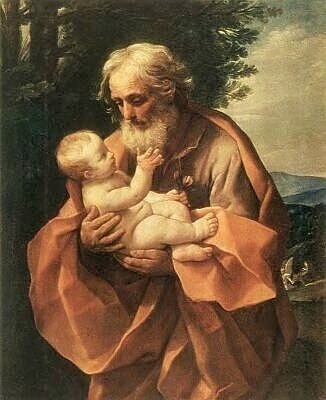
Before you think that I've gone off the reservation, this Friday, March 19 is the Solemnity of St. Joseph, Husband of Mary. What is a Solemnity?
SOLEMNITY
A Solemnity of the Roman Catholic Church observes an event in the life of Jesus, Mary, and the saints, beginning on the evening prior to actual date. Solemnity is made up of Latin words solet and annus, meaning a yearly (annual) celebration. They are observed throughout the entire Church.
In terms of importance, Solemnities are the biggest celebrations and observances in the Catholic Church. To put it in perspective, two of the other seventeen Solemnities are Christmas and Easter. After Solemnities, come feasts and then memorials.

Since it doesn't really get any bigger, it is safe to say that a solemnity is a party day, a celebration. Therefore it is appropriate to act joyous -- even during Lent. In fact, you don't have to abstain from meat on this Friday in Lent. Our priest even went so far one year as to say: please eat meat this Friday.
According to Canon 1251, abstinence from meat is lifted on Fridays that occur on a Solemnity. Faithful who eat meat on March 19, the Solemnity of Saint Joseph, would not be breaking the Lenten law of abstinence. Source: http://www.arlingtondiocese.org
Naturally, this feels like it goes against the grain of what we've been taught as faithful Catholics. People get very nervous, as if the Meat Patrol will catch them and punish them for eating meat on a Friday in Lent. Some will say that this is just taking advantage of a loophole, being legalistic, or may just feel guilty.

This is nonsense! The Church has told you to celebrate on this day, the same as she told you to fast and abstain during Lent. Let's remember: all these things, whether fasting or feasting, are designed to draw us closer to God. To borrow a phrase: let's not try to be more Catholic than the Pope.

So why celebrate St. Joseph as the Husband of Mary? St. Joseph is an awesome saint. Despite the circumstances, he obeyed and believed the Holy Spirit when He told Joseph to take Mary as his wife, despite her unexplained pregnancy. Not much is known about Joseph, except that he was a carpenter, of the royal line of David, and Scripture describes him as a "righteous man".

Now this is how the birth of Jesus Christ came about. When his mother Mary was betrothed to Joseph, 7 but before they lived together, she was found with child through the holy Spirit.
19
Joseph her husband, since he was a righteous man, 8 yet unwilling to expose her to shame, decided to divorce her quietly.
20
Such was his intention when, behold, the angel of the Lord 9 appeared to him in a dream and said, "Joseph, son of David, do not be afraid to take Mary your wife into your home. For it is through the holy Spirit that this child has been conceived in her.
21
She will bear a son and you are to name him Jesus, 10 because he will save his people from their sins."
22
All this took place to fulfill what the Lord had said through the prophet:
23
11 "Behold, the virgin shall be with child and bear a son, and they shall name him Emmanuel," which means "God is with us."
24
When Joseph awoke, he did as the angel of the Lord had commanded him and took his wife into his home.
25
He had no relations with her until she bore a son, 12 and he named him Jesus. (Matt 1:19-25)

If this were a screenplay, Joseph might have a grievance: he doesn't even have any lines in Scripture! (Must be the strong, silent type.) But he does what is asked of him and provided a home and protection for Mary and Jesus.

Joseph is a model and an inspiration - much more could be said; however, may it be said of us men at the end of our lives that we, too, were righteous.

St. Joseph, Husband of Mary, ora pro nobis.

Thursday, March 19, 2009

St. Joseph's Day - March 19

It's party time! Today is the Solemnity of the feast of St. Joseph. Do you know what that means boys and girls? No fast and abstinence -- it's an oasis in the desert of Lent. So, have a cookie!
(h/t Fisheaters for the picture!)

St. Joseph's Day -- Because March 19 always falls during Lent, St. Joseph's Day feasts often have no meat, even though—because the feast day is classed as a solemnity—abstinence from meat is not required according to Canon law, even if it falls on a Friday. If the feast day falls on a Sunday (other than Palm Sunday), it is observed on the next later available date instead: this is the following day, Monday, March 20.

From 2008 onwards, if St Joseph's Day falls during Holy Week, it is moved to the next earlier available date, usually the Saturday before Holy Week. This change was announced by the Congregation for Divine Worship in Notitiae March-April, 2006 (475-476, page 96). The idea was to avoid the "traffic jam" that would occur under the old rules if both St Joseph's Day and the Annunciation had to be moved to the first available date after Easter Week.

LinkWithin

Related Posts with Thumbnails