He is waiting for you.

Showing posts with label lent. Show all posts
Showing posts with label lent. Show all posts
Wednesday, March 16, 2011


Tuesday, March 8, 2011

Monday, March 7, 2011
Pray A Priestess Home
Our pal LarryD at Acts of the Apostasy has just had a brilliant idea. True, most of his ideas are super-snarky (which keeps us laughing) but this one's for realz.
Inspired by the true life return to full communion with the Catholic Church by a woman who attempted to be ordained, LarryD is organizing a prayer campaign for those associated with RCWP.
 Document of Renunciation of Ordination to Diaconate by Norma Jean Coon.
Wondering what to do for Lent? Why not help someone return home to the Catholic Church? Click on over and give LarryD your support. Pray on!
Pray for the conversion of: Chava Redonnet
Inspired by the true life return to full communion with the Catholic Church by a woman who attempted to be ordained, LarryD is organizing a prayer campaign for those associated with RCWP.
Last week's story of Norma Jean Coon publicly renouncing her association with RCWP and attempt at ordination to the diaconate really moved me. It was a bright light of hope in a week of dark, despairing news. Perhaps it's the initial sign that the womynpreest movement is beginning to crack. Thus, we should all help it along.
That's why I've decided to launch the "Adopt-A-Priestess Project", which is not all that dissimilar from "Adopt A Seminarian" initiatives some dioceses have, or the Spiritual Adoption of Unborn Human Life that had been encouraged by Archbishop Fulton J. Sheen.
Wondering what to do for Lent? Why not help someone return home to the Catholic Church? Click on over and give LarryD your support. Pray on!
Pray for the conversion of: Chava Redonnet
Wednesday, March 31, 2010
Tenebrae
Soon all will be as shadows. The darkness comes and seems to overwhelm all in the Church - all is sorrowful. We know that this is not the end, that the light is only hidden and that Jesus rises from the dead.
But for now - shadows.
Mrs. Nod and I were able to get to confession one last time before Easter; Wynken and Blynken went on Sunday at the Grotto in Emmitsburg. From that perspective, I'd say we were ready for Easter.
Here is how the Sisters of Carmel celebrate Tenebrae.
But for now - shadows.
Mrs. Nod and I were able to get to confession one last time before Easter; Wynken and Blynken went on Sunday at the Grotto in Emmitsburg. From that perspective, I'd say we were ready for Easter.
Here is how the Sisters of Carmel celebrate Tenebrae.

“Tenebrae” is the name given to the service of Matins and Lauds belonging to the last three days of Holy Week. It differs, in many things, from the Office of the rest of the year. All is sad and mournful, as though it were a funeral service; nothing could more emphatically express the grief that now weighs down the heart of our holy Mother the Church. Throughout all the Office of Thursday, Friday and Saturday, she forbids herself the use of those formulas of joy and hope wherewith, on all other days, she begins her praise of God. Nothing is left but what is essential to the form of the Divine Office: psalms, lessons and chants expressive of grief. The tone of the whole Office is most noticeably mournful: the lessons taken from the Lamentations of Jeremias, the omission of the Gloria Patri, of the Te Deum, and of blessings etc., so the darkness of these services seems to have been designedly chosen to mark the Church’s desolation. The lessons from Jeremias in the first Nocturn, those from the Commentaries of St. Augustine upon the Psalms in the second, and those from the Epistles of St. Paul in the third remain now as when we first hear of them in the eighth century.
The Agony in the Garden The name “Tenebrae” has been given because this Office is celebrated in the hours of darkness, formerly in the evening or just after midnight, now the early morning hours. There is an impressive ceremony, peculiar to this Office, which tends to perpetuate its name. There is placed in the sanctuary, near the altar, a large triangular candlestick holding fifteen candles. At the end of each psalm or canticle, one of these fifteen candles is extinguished, but the one which is placed at the top of the triangle is left lighted. During the singing of the Benedictus (the Canticle of Zachary at the end of Lauds), six other candles on the altar are also put out. Then the master of ceremonies takes the lighted candle from the triangle and holds it upon the altar while the choir repeats the antiphon after the canticle, after which she hides it behind the altar during the recitation of the Christus antiphon and final prayer. As soon as this prayer is finished, a noise is made with the seats of the stalls in the choir, which continues until the candle is brought from behind the altar, and shows, by its light, that the Office of Tenebrae is over.
Our Lady of Sorrows Let us now learn the meaning of these ceremonies. The glory of the Son of God was obscured and, so to say, eclipsed, by the ignominies He endured during His Passion. He, the Light of the world, powerful in word and work, Who but a few days ago was proclaimed King by the citizens of Jerusalem, is now robbed of all his honors. He is, says Isaias, the Man of sorrows, a leper (Isaias 53:3,4). He is, says the royal prophet, a worm of the earth, and no man (Psalm 21:7). He is, as He says of himself, an object of shame even to his own disciples, for they are all scandalized in him (Mark 14:27) and abandon Him; yea, even Peter protests that he never knew Him. This desertion on the part of His apostles and disciples is expressed by the candles being extinguished, one after the other, not only on the triangle, but on the altar itself. But Jesus, our Light, though despised and hidden, is not extinguished. This is signified by the candle which is momentarily placed on the altar; it symbolizes our Redeemer suffering and dying on Calvary. In order to express His burial, the candle is hidden behind the altar; its light disappears. A confused noise is heard in the house of God, where all is now darkness. This noise and gloom express the convulsions of nature when Jesus expired on the cross: the earth shook, the rocks were split, the dead came forth from their tombs. But the candle suddenly reappears; its light is as fair as ever. The noise is hushed, and homage is paid to the Conqueror of death.
Thursday, February 18, 2010

Tuesday, September 1, 2009
The Gargoyle Code
Fr. Longenecker is at it again with a new book called The Gargoyle Code which is written in the tradition of The Screwtape Letters.
Fr. L. discusses his new book in a podcast here. Check out Fr. L. as he reads a letter from the book! Very cool! Fr. L. says this book is just right for Lent (thinking ahead).
Fr. L. discusses his new book in a podcast here. Check out Fr. L. as he reads a letter from the book! Very cool! Fr. L. says this book is just right for Lent (thinking ahead).
Here's a podcast in which I speak about Screwtape Letters and my new book Gargoyle Code. Tell your friends to tune in please. If you have a blog, I'd love you to link to the podcast.The book is available through St Benedict Press, and will soon be available for purchase through my website. If you would like a signed copy just send me an email: dlongenecker@charter.net and let me know how many copies you would like, and the address to which it should be sent. Then go to the 'Donate' button in the right sidebar of the blog and donate the amount we agree. (one book is $15.00 which includes p+p, but more than one costs less)

Thursday, March 19, 2009
St. Joseph's Day - March 19
It's party time! Today is the Solemnity of the feast of St. Joseph. Do you know what that means boys and girls? No fast and abstinence -- it's an oasis in the desert of Lent. So, have a cookie!
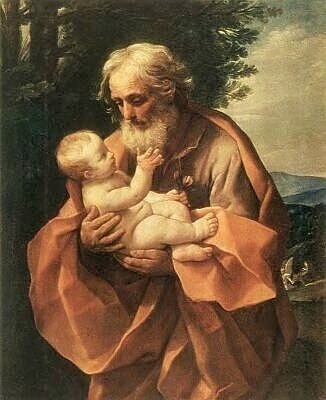
St. Joseph's Day -- Because March 19 always falls during Lent, St. Joseph's Day feasts often have no meat, even though—because the feast day is classed as a solemnity—abstinence from meat is not required according to Canon law, even if it falls on a Friday. If the feast day falls on a Sunday (other than Palm Sunday), it is observed on the next later available date instead: this is the following day, Monday, March 20.
From 2008 onwards, if St Joseph's Day falls during Holy Week, it is moved to the next earlier available date, usually the Saturday before Holy Week. This change was announced by the Congregation for Divine Worship in Notitiae March-April, 2006 (475-476, page 96). The idea was to avoid the "traffic jam" that would occur under the old rules if both St Joseph's Day and the Annunciation had to be moved to the first available date after Easter Week.
Saturday, March 7, 2009
The Resurrection of Herod
Today we watched another hour of that classic film Jesus of Nazareth as part of our family Lenten observance. The striking scene in the second hour is when King Herod the Great demands the death of all male children two years and under in Bethlehem.
In the same way, today, it's a bad day to be a baby. What is it with left-wing social engineering? Every other day they advocate a new kind of death: abortion, ESCR, euthanasia, infanticide; and follow it up with policies of sterility and eugenics: birth control, gay "marriage", test tube babies, selective reduction, anti-religious bigotry.
It's SO sterile: death and hatred, race politics and income redistribution, enforced groupthink. "We're tolerant and open minded -- and we'll kill anyone who disagrees with us."
It's easy to get down -- bad news abounds. But just as God had a plan for His Son to escape the Herod of two thousand years ago, God will deliver us from this present darkness and the modern day Herods.
And not only escape, but triumph.
So as we make our way through this Lent, we have the opportunity to meditate on the mystery of evil and the awesome redemptive power of God to make all things new. Let it begin with me.
"Kill! Kill them all!Never mind I think he sounds like Prince John in Disney's version of Robin Hood. He is just as angry and petulant, but even more dangerous since he knows no boundaries except his own comfort and power.
Kill! Kill them all!
Better the innocent should die then the guilty should escape!"
In the same way, today, it's a bad day to be a baby. What is it with left-wing social engineering? Every other day they advocate a new kind of death: abortion, ESCR, euthanasia, infanticide; and follow it up with policies of sterility and eugenics: birth control, gay "marriage", test tube babies, selective reduction, anti-religious bigotry.
It's SO sterile: death and hatred, race politics and income redistribution, enforced groupthink. "We're tolerant and open minded -- and we'll kill anyone who disagrees with us."
It's easy to get down -- bad news abounds. But just as God had a plan for His Son to escape the Herod of two thousand years ago, God will deliver us from this present darkness and the modern day Herods.
And not only escape, but triumph.
So as we make our way through this Lent, we have the opportunity to meditate on the mystery of evil and the awesome redemptive power of God to make all things new. Let it begin with me.
Wednesday, March 4, 2009
Maybe It's God
Washington Archbishop Donald Wuerl just busted my #1 myth about the Catholic Church: she doesn't advertise.
In my travels during my working life, I have had many occasions to visit various Catholic churches in various American cities, whether it be for Sunday Mass, or more likely a holy day of obligation. As every practicing Catholic adult knows who has been forced to travel on such a day, MassTimes.org is your one stop shop for this kind of thing. If that doesn't work, Google Maps will substitute in a pinch; failing that, every hotel I've even been to had some kind of card or printout directing you to the three nearest Catholic churches.
Open your local paper to the religion section and you'll see all kinds of ads for various Protestant or Bible Churches and a random religion or two; this is especially true around Easter. What you don't find is any ads for Catholic churches. Same thing goes for the Yellow Pages.
Strange? Curious? Why don't Catholic churches advertise? The answer is simple: they don't need to. Everybody knows, if you're Catholic you go to the local Catholic church -- there's no thought required. Oh, there are those Catholics who'll avoid St. Cecelia's because "Fr. Mike doesn't do it right" and go to St. Mary of the Valley because they like the folk mass, but that's a kind of intra-Catholic shopping.
Those other churches advertise because they need the membership, and that equals financial support. They need to advertise to get people to come to their particular church to stay in business. "Come to our church because we've got great preaching and fellowship".
Catholic churches don't need membership for the same reasons that independent churches do. Catholics are generally numerous enough (in cities) that they don't advertise to increase their numbers -- they have a built-in audience. Catholic churches are set up by the diocese to serve the faithful -- hey, we got Catholics here who need sacraments and stuff, we'd better send a priest. Yes, the faithful have to support the local church or it'll fold too, but the rationale is different and benefits from diocesan central planning.
Now, I may have to revise my theory in part. I was driving home from work when I heard Archbishop Wuerl on the radio inviting fallen away Catholics to "come home" this Lent. I nearly fell out of the car. was the ad. Archbishop Wuerl has a soft spoken, sing-songy kind of voice. Maybe his voice is really just "pastoral", but the acoustic muzak that accompanied the ad made it sound sort of stereotypical "churchy". As soon as I got home, I looked it up on the Web -- sure enough, it's a real campaign put on by the Archdiocese of Washington.
There is an accompanying YouTube video of Archbishop Wuerl inviting those who have drifted away to rediscover their faith and their church. I must say he carries it off much better on video than in the radio ad. What I do like about it is that it is a personal invitation, and that's what people will respond to -- not heurmeneutics, not a general plea, not the promise of better music.
ADW has a decent Web site: it has a personal instead of an official feel to it, including a blog. The Archdiocese and the Church in general are starting to really embrace technology to reach the people. There's still a ways to go, but you gotta give 'em props for trying.
In my travels during my working life, I have had many occasions to visit various Catholic churches in various American cities, whether it be for Sunday Mass, or more likely a holy day of obligation. As every practicing Catholic adult knows who has been forced to travel on such a day, MassTimes.org is your one stop shop for this kind of thing. If that doesn't work, Google Maps will substitute in a pinch; failing that, every hotel I've even been to had some kind of card or printout directing you to the three nearest Catholic churches.
Open your local paper to the religion section and you'll see all kinds of ads for various Protestant or Bible Churches and a random religion or two; this is especially true around Easter. What you don't find is any ads for Catholic churches. Same thing goes for the Yellow Pages.
Strange? Curious? Why don't Catholic churches advertise? The answer is simple: they don't need to. Everybody knows, if you're Catholic you go to the local Catholic church -- there's no thought required. Oh, there are those Catholics who'll avoid St. Cecelia's because "Fr. Mike doesn't do it right" and go to St. Mary of the Valley because they like the folk mass, but that's a kind of intra-Catholic shopping.
Those other churches advertise because they need the membership, and that equals financial support. They need to advertise to get people to come to their particular church to stay in business. "Come to our church because we've got great preaching and fellowship".
Catholic churches don't need membership for the same reasons that independent churches do. Catholics are generally numerous enough (in cities) that they don't advertise to increase their numbers -- they have a built-in audience. Catholic churches are set up by the diocese to serve the faithful -- hey, we got Catholics here who need sacraments and stuff, we'd better send a priest. Yes, the faithful have to support the local church or it'll fold too, but the rationale is different and benefits from diocesan central planning.
Now, I may have to revise my theory in part. I was driving home from work when I heard Archbishop Wuerl on the radio inviting fallen away Catholics to "come home" this Lent. I nearly fell out of the car.
"Longing for Something? Maybe It's God."
There is an accompanying YouTube video of Archbishop Wuerl inviting those who have drifted away to rediscover their faith and their church. I must say he carries it off much better on video than in the radio ad. What I do like about it is that it is a personal invitation, and that's what people will respond to -- not heurmeneutics, not a general plea, not the promise of better music.
ADW has a decent Web site: it has a personal instead of an official feel to it, including a blog. The Archdiocese and the Church in general are starting to really embrace technology to reach the people. There's still a ways to go, but you gotta give 'em props for trying.
Thursday, February 26, 2009
iBishop's Lenten Menu
The USCCB has some cool resources on their web site specifically geared to help the faithful in their observance of Lent, including What We Believe, What We Celebrate, How We Live, and How We Pray.
The Bishops are coming of Internet Age in trying to both reach and teach the Catholic faithful -- even the most wired. Check it out.
The Bishops are coming of Internet Age in trying to both reach and teach the Catholic faithful -- even the most wired. Check it out.
 | What We Believe |
 | What We Celebrate Catholics celebrate the Christian mystery through our liturgy and the seven sacraments of the Church. Learn more about the sacraments, especially the sacraments of Baptism and Reconciliation (Confession) during Lent. |
 | How We Live Christian living means following the teaching and example of Christ, the Ten Commandments, the precepts of the Catholic Church and its principles of moral life. In this section, learn more about Christian morality and the special emphasis on fasting and charity during Lent. |
 | How We Pray Through prayer, we raise our hearts and minds to God in thanksgiving and praise. Learn about the types of Christian prayer and the special prayers and devotions of Lent. |
Sunday, February 22, 2009

Subscribe to:
Posts (Atom)
LinkWithin
