Showing posts with label hacking. Show all posts

Wednesday, May 19, 2010

Hacking Your Car

Ok, so remember all the brouhaha not so long ago about Toyota cars having sudden acceleration and braking problems? Toyota initially said it was floor mats, and then a braking pedal shim needed to be added.

And then Popular Mechanics piled on and showed conclusively that the braking problems were all mechanical and not electronic.
[Popular Mechanics] But the possibility that a vehicle could go from idling at a traffic light to terrific, uncalled-for and uncontrollable acceleration because the guy next to you at a traffic light answered his cellphone? Or some ghost in the machine or a hacker caused a software glitch that made your car run away and the brakes suddenly simultaneously fail? Not in the least bit likely.

These throttle-by-wire systems are very difficult to confuse—they're designed to be robust, and any conceivable failure is engineered to command not an open throttle but an error message.

Remember how some people were caught being liars and gold diggers? Then there were the graphs and interpolations of data that showed that old people were disproportionately victims of Sudden Unintended Acceleration (SUA) - a not so subtle hint that the geezers were pushing the accelerator when they thought they were pushing the brake. Oops.


And then Toyota came out and said there was a problem with software causing braking problems after all, but it was nothing like this "runaway" problem that people were reporting. And there were Congressional hearings and fines levied and then we all breathed a collective sigh of relief because it was all overblown in the first place.

Remember all that, mister? Do you? Huh, do you?

Well nobody is calling out any companies by name, but a team of geeks led by Stefan Savage, an associate professor with the University of California-San Diego, and Tadayoshi Kohno of the University of Washington successfully hacked a car's computer to make it do all kinds of things you're not "supposed" to be able to do, including "turn off the brakes in a moving car, change the speedometer reading, blast hot air or music on the radio, and lock passengers inside the car".

They built a custom analyzer called CARSHARK and plugged it into the industry standard computer access port under the hood.

In the United States, the federally-mandated On- Board Diagnostics (OBD-II) port, under the dash in virtually all modern vehicles, provides direct and standard access to internal automotive networks. User-upgradable subsystems such as audio players are routinely attached to these same internal networks, as are a variety of short- range wireless devices (Bluetooth, wireless tire pressure sensors, etc.). Telematics systems, exemplified by General Motors’ (GM’s) OnStar [service].

Fuzzing. Much to our surprise, significant attacks do not require a complete understanding or reverse-engineering of even a single component of the car. In fact, because the range of valid CAN packets is rather small, significant damage can be done by simple fuzzing of packets (i.e., iterative testing of random or partially random packets). In- deed, for attackers seeking indiscriminate disruption, fuzzing is an effective attack by itself. [source]
Oh, and then they did the whole thing over again by remote control. Yeah.

Read the entire thing here.

I'm a computer security guy and I find this the Coolest. Thing. Ever. (also scary). So it's not like I'm saying "I told you so" or anything ... OK, who are we kidding? I am saying it. I told you so.

Wednesday, December 30, 2009

Quantum Hacking

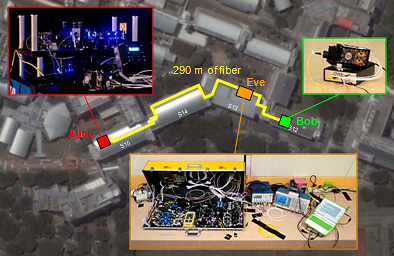
These folks over at NTNU have discovered a way of hacking quantum cryptography by eavesdropping on the communications through flaws in the hardware.

Quantum hacking = cool.
"Inclusive" language = annoying.


Eavesdropping experiment on campus map Scheme of experiment

(Source) The Quantum Hacking group works in the field of quantum cryptography and quantum information. In quantum information science the information unit is not a bit, but rather a quantum bit – qubit. A qubit may not only be zero or one, but also zero and one simultaneously!

In our work, we use photons as physical representation of qubits. Quantum cryptography is a method of secure communication using qubits. Such communication is based on the Heisenberg uncertainty principle. If an eavesdropper listens to qubits, she changes them, which is inevitably noticed by the legitimate users. That is, any attempt of eavesdropping will be caught.

Friday, August 14, 2009

Hacking The Pump?

Ever wonder how a gas pump works? They are fascinating pieces of technology that we all but take for granted. They mechanics are cool, but ultimately not that complicated. These days the "important" parts are done by computer. (The important part being paying for it.)
[HSW] As the gasoline travels upward into the dispenser, it passes through a flow control valve that regulates the gasoline's flow speed. It does this via a plastic diaphragm that gets squeezed more and more tightly into the pipe as the flow of gas increases, always leaving just enough room for the proper amount of gasoline to get through.

This pipe also contains the flow meter, which is a cast iron or aluminum chamber containing a series of gears or a simple rotor that ticks off units of gas as they pass through. Information about the gas flow is passed on to a computer located in the dispenser, which displays the metered amount of gas in tenths of a gallon.

In the 1970s, glowing LCDs in the form of seven-segment displays began to appear. (The segments in the display could be illuminated by computer to form various numerals and occasionally letters of the alphabet.)

These relatively simple user interfaces are gradually being replaced by full-fledged computer video displays, many running variations on operating systems like Microsoft Windows. These displays can offer information, display the amount of gas being sold and even run advertisements and carry on simple conversations with amused customers.
I actually find these computer / video displays really annoying. I just want to pump gas and leave. I don't want the news, the weather, or a car wash. Since I know a thing or two about computer [in]security, I'm always a bit skeptical about computerizing everything.

So imagine my somewhat amused surprise when I pulled in to fill up at the local gas shack and I see this:
If you look closely you can see this is a Windows computer. The task bar is the lighter bar at the bottom of the screen, the system tray is in the right hand corner, and there are 3 applications/windows open. There is a popup window in the middle of the screen with the classic "Do this / Cancel" combination. I wonder what it says?

If you squint hard (or click for larger image) at my still life with cell phone picture, you can make out the message "An updated version of LogMeIn has been downloaded and is ready for install. Click Update to install the new version now."

Remote access and desktop control to the gas pump? Interesting. Foolish, but interesting. Have these people never heard of EvilGrade, "a toolkit for exploiting products which perform online updates in an insecure fashion"?

Fake updates, plus remote desktop access to the gas pump. Wow. I'll bet nobody ever thought of hacking the pump before now.

It's not that far-fetched. Now I don't know if this computer is controlling the pump, or just the annoy-ware video, but it doesn't matter. I know you're sleeping better at night knowing that Micro$oft products may be controlling the gas pumps and your credit card number. I mean, what could go wrong?

LinkWithin

Related Posts with Thumbnails